Homeschool (March 2022 - ), Virtual and in-person special private school - grade 7 (Sept 2021-March 2022), Virtual-only public school and special private school tutoring - grade 6 (2020-2021), School Closure (March-May 2020), Public School grades 3-5 (Sept 2017-March 2020), Montessori School K-2nd (2014-2017)
David is having trouble sleeping again. I thought he was getting a lot of sleep - becoming a typical teenager - but then he started talking about (and returning to the topic often) of how do you know when you're asleep? I finally figured out that he thought that lying quietly with your eyes closed is the same as sleeping.
We're increasing the melatonin he's taking, first recommended by his pediatrician when he was two. He's also taking chamomile and valerian before bed, which have less research proving effectiveness but also few side effects, as well as smelling lavender at bedtime, or if he's awake in the night. We just switched his vitamins to the morning, to take with breakfast, because vitamin D helps with sleep and is much more effective when taken with food.
A good night’s rest isn’t guaranteed for anyone, but it is downright elusive for many people with autism. Individuals on the spectrum often have trouble falling and staying asleep. And that may worsen certain features of their condition, such as repetitive behaviors, which can, in turn, make sleeping even more difficult. Given this disruptive feedback loop, sleep problems are among the most urgent concerns for families grappling with autism. But so far, this also happens to be among the least-studied aspects of autism. Here’s what researchers know so far about the causes and consequences of — and treatments for — sleep problems in autism.
How common are sleep problems in children with autism?
A 2019 study, one of the largest to investigate the prevalence of sleep problems in autism, suggested that nearly 80 percent of autistic preschoolers have disrupted sleep. Sleep problems are twice as common among children with autism as they are among typical children or those with other developmental conditions.
What types of sleep problems are common in autism?
People with autism tend to have insomnia: It takes them an average of 11 minutes longer than typical people to fall asleep, and many wake up frequently during the night. Some people with the condition have sleep apnea, a condition that causes them to stop breathing several times during the night.
Sleep in people with autism may also be less restorative than it is for people in the general population. They spend about 15 percent of their sleeping time in the rapid eye movement (REM) stage, which is critical for learning and retaining memories. Most neurotypical people, by contrast, spend about 23 percent of their nightly rest in REM.
Does this lack of good sleep have consequences?
There is mounting evidence that too little sleep can exacerbate autism features, such as poor social skills. Children who do not get enough sleep often have more severe repetitive behaviors and a tougher time making friends than other people on the spectrum. They also tend to score lower on tests of intelligence. However, it is unclear whether these problems stem from poor sleep, contribute to it or both.
Why do people with autism have difficulty sleeping?
Many people with autism have other conditions, such as gastrointestinal problems, attention deficit hyperactivity disorder (ADHD) or anxiety, and each of those is known to disrupt sleep. Sensory sensitivities to light, sound or touch may contribute to difficulty sleeping. Sleep problems may also be an indicator of depression in autistic people, though whether it is a cause or a result of sleep difficulties is unclear.
People with these other conditions may also take medications that affect sleep. For example, many people with ADHD take stimulants, which are known to cause insomnia.
In some cases, people on the spectrum carry mutations that make them prone to sleep problems. Studies suggest that individuals with autism are more likely than typical people to have mutations in genes that govern the sleep-wake cycle or those that have links to insomnia. Some studies suggest that people on the spectrum carry mutations that affect levels of melatonin, a natural hormone that controls sleep.
How can researchers assess sleep problems in people with autism?
Polysomnography is the most common and thorough type of sleep test. It tracks a person’s brain waves, eye and limb movement, and breathing patterns during sleep. Because it requires multiple sensors, wires and computers, it is typically done in a lab.
But this gold-standard method is not always practical for people with autism, many of whom require specific routines at bedtime. At least one research group has brought polysomnography equipment into the homes of people with autism to try to get around this problem.
A less cumbersome sleep test is actigraphy, in which a wristwatch-like device records a person’s movements throughout the night. People can use the device at home to record the amount of time a person sleeps each night.
Researchers can also learn about sleep patterns by interviewing families or asking them to maintain sleep diaries. But these methods are error-prone because they rely on people’s memories.
Are there treatments available to help people with autism sleep better?
In some ways, the fix can be straightforward: Establishing a routine, such as an order of activities at bedtime, can often help a person fall asleep; so can changing the temperature or lighting in a bedroom. Sticking with regular bed and wake times can put the brain and body on a schedule that makes sleep more reliable.
For many sleep issues, melatonin supplements may be a good option. Some research suggests the supplements help children with autism fall asleep faster and get better-quality sleep.
Would better sleep improve quality of life for people on the spectrum?
Maybe. No large, definitive study exists on this topic. But research has shown that typical children and those with autism who undergo surgery to alleviate breathing trouble during sleep show better social communication and attention as well as fewer repetitive behaviors. Parents reported similar improvements in a small study of children with autism who took melatonin supplements.
David was asking me lots of questions about WWII, why Germany bombed London, what Churchill's job was like, and so on, so I told him to talk to Eric. Now David is asking Eric how do you know if a country has surrendered, and so on. (I'm in the other room, shopping on Amazon.)
David and I saw the planets tonight, looking out his bedroom window. They looked like a big, bright star. I don't know if we'll get to see it again; it's supposed to be cloudy the next few nights.
What has become known popularly as the “Christmas Star” is an especially vibrant planetary conjunction easily visible in the evening sky over the next two weeks as the bright planets Jupiter and Saturn come together, culminating on the night of Dec. 21.
The planets regularly appear to pass each other in the solar system, with the positions of Jupiter and Saturn being aligned in the sky about once every 20 years.
What makes this year’s spectacle so rare, then? It’s been nearly 400 years since the planets passed this close to each other in the sky, and nearly 800 years since the alignment of Saturn and Jupiter occurred at night, as it will for 2020, allowing nearly everyone around the world to witness this “great conjunction.”
The closest alignment will appear just a tenth of a degree apart and last for a few days. On the 21st, they will appear so close that a pinkie finger at arm’s length will easily cover both planets in the sky. The planets will be easy to see with the unaided eye by looking toward the southwest just after sunset.
From our vantage point on Earth the huge gas giants will appear very close together, but they will remain hundreds of millions of miles apart in space. And while the conjunction is happening on the same day as the winter solstice, the timing is merely a coincidence, based on the orbits of the planets and the tilt of the Earth.
“Conjunctions like this could happen on any day of the year, depending on where the planets are in their orbits,” said Throop. “The date of the conjunction is determined by the positions of Jupiter, Saturn, and the Earth in their paths around the Sun, while the date of the solstice is determined by the tilt of Earth’s axis. The solstice is the longest night of the year, so this rare coincidence will give people a great chance to go outside and see the solar system.”
For those who would like to see this phenomenon for themselves, here’s what to do:
Find a spot with an unobstructed view of the sky, such as a field or park. Jupiter and Saturn are bright, so they can be seen even from most cities.
An hour after sunset, look to the southwestern sky. Jupiter will look like a bright star and be easily visible. Saturn will be slightly fainter and will appear slightly above and to the left of Jupiter until December 21, when Jupiter will overtake it and they will reverse positions in the sky.
The planets can be seen with the unaided eye, but if you have binoculars or a small telescope, you may be able to see Jupiter’s four large moons orbiting the giant planet,
Each night, the two planets will appear closer low in the southwest in the hour after sunset
David's on-line tutor for reading comprehension (the Visualizing and Verbalizing program) is leaving after winter break to finish her last semester of college. This is what she wrote in an email to me:
Working with David has been one of my [tutoring] highlights. He has such a great sense of humor, an incredible work ethic, and an astonishing imagination. I am so excited to cheer him on as he continues to grow as a student.
David started a discussion with Eric about Chernobyl. They talked about the disaster, and how trees have grown up, and scientists go into the "ghost city" but only wild animals live there now.
What's the difference between the House of Commons and Congress?
One might ponder this on a Tuesday morning after breakfast, in between thinking about how there aren't as many trees on the prairies (temperate grasslands), and reading about Indonesia in a world atlas.
Garglemel the Yeti had a giant gorilla face and body. The color of his fur was white. His hands and feet were big. The ground shook near him when he walked. On the mountain he talked and played with the other Yetis but when he wanted to do something different he went down the mountain to the town in the valley.
The nearer he got the more the ground shook and if he was near a small run down shack it fell. The people said, ‘’ THE YETI IS COMING!’’ Some people said, ‘’ I CAN SEE HIM!’’ Other people said, ‘’ I CAN HEAR HIM!’’
At any time of the day if he was hungry he’d eat small and thin people and babies. So they got into a big Yeti costume to hide. The Yeti thought that it was another Yeti so he went back up the mountain to his cave. The people were relieved!
David has had four virtual tutoring sessions in the Visualizing and Verbalizing method, which have been really great, lots of communication with his tutor.
He took an online 6th grade phonics reading test and scored 9 out of 10.
He's reading The Wind in the Willows, the original version, and tells me all about it after each reading. He has his headphones on for Listening Therapy while he reads.
On a 6th grade social studies pre-assessment, David labeled all 7 continents and 4 oceans correctly. (It helps that he's a geography guy, plus in Montessori school the students learn the continents in the primary level.)
David wrote a spooky story and a song about Halloween with Mimi.
The COVID-19 pandemic has taken a disproportionate toll on people with intellectual and developmental disabilities (IDDs), write the directors of the Intellectual and Developmental Disabilities Research Centers (IDDRC).
A large number of people with IDD who require in-person care have lost the support of trained caregivers and community service providers due to the pandemic. The authors note that the Centers for Disease Control and Prevention and others have issued guidelines for group homes, schools, and others entrusted with the care of people with IDD. It is vital to ensure that when they return to work, care staff exercise techniques and procedures to protect their clients from infection, the authors write. Moreover, people with IDD depend on caregivers and loved ones to help them bridge gaps in intellectual and communication abilities. In the absence of this human contact, the authors call for virtual care and support, where viable. Those who cannot benefit from screen-based supports should be prioritized to receive in-person services.
Suspension of classroom time also disproportionately affects children with IDD, who often require special educational services, increased teacher-student ratios, and specialized interventions, many of which need to be administered in person, the authors note. It is difficult for families to take on these tasks, and qualified in-home surrogates should be mobilized whenever possible to meet this need and to support parents’ efforts.
Also, people with IDD often cannot verbalize their symptoms during telemedicine appointments, and physicians need to use their best judgement in providing in-person care for them when necessary, according to the authors. The article emphasizes that people with IDD who are infected with COVID-19 should receive equal access to testing and appropriate medical care.
COVID-19 is a new disease and we are still learning how it spreads, the severity of illness it causes, and to what extent it may spread in the United States.
Disability alone may not be related to higher risk for getting COVID-19 or having severe illness. Most people with disabilities are not inherently at higher risk for becoming infected with or having severe illness from COVID-19. However, some people with disabilities might be at a higher risk of infection or severe illness because of their underlying medical conditions. All people seem to be at higher risk of severe illness from COVID-19 if they have serious underlying chronic medical conditions like chronic lung disease, a serious heart condition, or a weakened immune system. Adults with disabilities are three times more likely than adults without disabilities to have heart disease, stroke, diabetes, or cancer than adults without disabilities.
If you have one of the disability types listed below, you might be at increased risk of becoming infected or having unrecognized illness.
People who have limited mobility or who cannot avoid coming into close contact with others who may be infected, such as direct support providers and family members
People who have trouble understanding information or practicing preventive measures, such as hand washing and social distancing
People who may not be able to communicate symptoms of illness
If you or someone you care for are athigher riskof getting very sick from COVID-19,take steps to prevent getting sick. In addition to practicing everyday preventive actions, people with disabilities who have direct support providers can help protect themselves from respiratory illness in the following ways:
Ask your direct support provider if they are experiencing any symptoms of COVID-19 or if they have been in contact with someone who has COVID-19
Tell your direct service provider to
Wash their hands when they enter your home and before and after touching you (e.g., dressing, bathing/showering, transferring, toileting, feeding), handling tissues, or when changing linens or doing laundry.
Clean and disinfect frequently touched objects and surfaces (e.g., counters, tabletops, doorknobs, bathroom fixtures, toilets, phones, keyboards, tablets, bedside tables), and equipment such as wheelchairs, scooters, walkers, canes, oxygen tanks and tubing, communication boards and other assistive devices.
There are some additional things people with disabilities can do to prepare during the COVID-19 outbreak:
Plan what you will do if you or your direct support provider gets sick. Create a contact list of family, friends, neighbors and local service agencies that can provide support in case you or your direct support provider becomes ill or unavailable.
Plan at least two ways of communicating from home and work that can be used rapidly in an emergency (e.g., landline phone, cell phone, text-messaging, email). Write down this information and keep it with you.
Have enough household items and groceries so that you will be comfortable staying home for a few weeks, at least a 30-day supply of over the counter and prescription medicines and any medical equipment or supplies that you might need. Some health plans allow for a 90-day refill on prescription medications. Consider discussing this option with your healthcare provider. Make a photocopy of prescriptions, as this may help in obtaining medications in an emergency situation.
Clinical research and experience over the last thirty years indicate there is a separate comprehension weakness that is rarely identified. This weakness often undermines the reading process…It is weakness, based in the sensory system, in creating an imaged gestalt.
1. Problem
Michelle reads words accurately, but she doesn’t understand what she reads. Words seem to “go in one ear and out the other” and she struggles with following directions. Her parents express frustration about her weak short term and long term memory. Her teachers think she is not trying, and she has been labelled as having ADHD.
2. Cause
A primary cause of language comprehension problems is difficulty creating an imagined gestalt. This is called weak concept imagery. This weakness causes individuals to get only “parts” of information they read or hear, but not the whole.
3. Symptoms
Individuals of all ages may experience the symptoms of a weakness in concept imagery. This causes weakness in:
Reading comprehension
Listening comprehension
Critical thinking and problem solving
Following directions
Memory
Oral language expression
Written language expression
Grasping humor
Interpreting social situations
Understanding cause and effect
4. Solution
The Visualizing and Verbalizing® program develops concept imagery—the ability to create an imagined or imaged gestalt from language—as a basis for comprehension and higher order thinking. The development of concept imagery improves reading and listening comprehension, memory, oral vocabulary, critical thinking, and writing.
Many people believe that Earth is closer to the sun in the summer and that is why it is hotter. And, likewise, they think Earth is farthest from the sun in the winter.
Although this idea makes sense, it is incorrect.
It is true that Earth's orbit is not a perfect circle. It is a bit lop-sided. During part of the year, Earth is closer to the sun than at other times. However, in the Northern Hemisphere, we are having winter when Earth is closest to the sun and summer when it is farthest away! Compared with how far away the sun is, this change in Earth's distance throughout the year does not make much difference to our weather.
There is a different reason for Earth's seasons.
Earth's axis is an imaginary pole going right through the center of Earth from "top" to "bottom." Earth spins around this pole, making one complete turn each day. That is why we have day and night, and why every part of Earth's surface gets some of each.
Sometimes it is the North Pole tilting toward the sun (around June) and sometimes it is the South Pole tilting toward the sun (around December).
It is summer in June in the Northern Hemisphere because the sun's rays hit that part of Earth more directly than at any other time of the year. It is winter in December in the Northern Hemisphere, because that is when it is the South Pole's turn to be tilted toward the sun.
Editor’s Note:In 1988, a teacher most commonly had 15 years of experience. In recent years, that number is closer to just three years leading a classroom. The “On Teaching” series focuses on the wisdom of veteran teachers.
A charming, bright 5-year-old stands out in his classroom at Maurice Wollin elementary school, on Staten Island, as an extremely social, kind, and curious child. He remembers more about his peers—names, significant events, likes and dislikes—than almost any other kindergartner at his school does.
But despite his genuine interest in his classmates and their well-being, he often struggles with interpreting their feelings and intentions—he has been diagnosed with autism spectrum disorder (ASD). (This 5-year-old and the other students mentioned in this article have been granted anonymity to protect their privacy.) One morning last month, in the middle of a math lesson, a soft-spoken classmate accidentally bumped into his shoulder, and quickly apologized with a big, friendly smile. But the [autistic] child concluded that his classmate was being mean, and punched him in the shoulder, then dropped to the floor, crying, his arms flailing and his voice growing louder.
In many classrooms, a teacher’s aide might have pulled him aside, attempted to help him calm down, and encouraged him to be quiet. If he didn’t comply, and continued to disrupt other students’ learning, he might have been sent to a counselor’s office or the principal’s office, or have been sent home for the day. (Across the nation, students with disabilities are suspended at twice the rate of students without them.)
Instead, within seconds of his dropping to the floor, his teacher, Tracy Murray, raised a laminated sign with an image of her classroom’s “clubhouse,” a special stress-relief area where kids who feel emotionally overwhelmed can take a break and use relaxation techniques that their teachers and therapists have recommended for them personally. There, he sank into a black beanbag chair and started slowly squeezing a pink ball in order to soothe himself.
Once he looked more relaxed, Murray, a 26-year veteran of special education, sat down next to him while her co-teacher, Elizabeth Garber, continued with the lesson. Because many children with autism learn better with visualaids, Murray drew a simple comic strip—with stick figures and dialogue balloons—to represent what had happened with the student and his classmate. Once he saw that the encounter was an accident and that he could make “smart guesses” about his peers’ intentions in the future by observing their facial expressions and listening to what they say, he calmed down and returned to the math lesson.
The scene in Murray’s classroom unfolded as it did because the kindergartner is part of a program called ASD Nest, which places students like him alongside neurotypical students in classrooms led by specially trained teachers. ASD Nest, which is named after its goal of giving kids with ASD a nurturing place to learn and grow, is a collaboration between the New York City Department of Education and NYU. It launched in 2003 with four teachers and has since expanded to 54 elementary, middle, and high schools in New York City.
Nationwide, more than half of students with autism ages 6 to 21 spend more than 40 percent of their school day in a majority-neurotypical classroom, with about two-thirds of this group spending 80 percent of their day in one. In general, the rest spend most of their school day in a special-education class or at a school where all students have one or more disabilities.
When a student on the spectrum is present, majority-neurotypical classrooms typically have one certified teacher—many without special-education training—and one or more teacher’s aides, who help students with special needs follow teachers’ directions and complete academic tasks. ASD Nest, meanwhile, places two certified and specially trained teachers in each participating classroom, which allows one of them to provide one-on-one social, emotional, or academic support whenever the need arises, without disrupting the lesson or pulling a student out of the classroom. On top of that, each classroom’s two co-teachers meet weekly with occupational, speech, and physical therapists to discuss each student’s progress and share observations about what’s working and what isn’t.
Murray, who was one of the inaugural Nest teachers, thinks that the program is effective because of its focus on collaboration among the ASD Nest teachers, school therapists, and university researchers, which results in frequent adjustments in the classroom activities and strategies tailored to every student. “We don’t expect students to learn the way we teach—we teach them the way they learn,” Murray told me at her school, sitting next to bookshelves covered by curtains in order to minimize visual stimulation, which can overwhelm some of her students on the spectrum, much like clutter, bright lights, and loud noises can.
Throughout the day, Murray and other teachers in the Nest program provide explicit guidance about emotional cues and social norms—information that can be elusive and invisible to children with autism. By the age of 5, many children can deduce that a smiling, friendly classmate is not looking to start a physical fight. Children with autism can struggle to reach that conclusion, but many special-education teachers, including Murray, believe that the ability to pick up on social cues can be taught in a classroom setting. ASD Nest is one of the few academic programs in the country that implements this approach in the classroom.
Last year, before the student Murray sat with in the clubhouse was enrolled in the program, he frequently struggled to make sense of social interactions and often stormed out of his preschool classroom in a panic, unable to return to class and missing out on learning. Two months into kindergarten, he hadn’t excused himself from his classroom once.
“We have a permission to prioritize social goals over academic lessons if we see an opportunity,” Murray said. That contrasts with the traditional approach to integrating students on the spectrum into majority-neurotypical classes, which prioritizes academic development, often without addressing the social and emotional challenges that can make classroom engagement difficult. The Nest approach, in the long run, can help give kids on the spectrum skills that they need in order to live with some degree of independence as adults.
Each Nest kindergarten class typically includes four students with autism and eight neurotypical students, and Murray maintains that the Nest approach benefits all students, not just those with developmental disorders. “Learning how to perceive the intentions and feelings of others and manage your own emotions is good for all students, not just autistic children,” she said.
Stephen Shore, a special-education professor at Adelphi University who has autism, thinks that Nest is effective because it focuses on addressing students’ strengths rather than their weaknesses. Too often, he says, programs for students on the spectrum dwell on their deficits, such as their inability to pay attention for long periods of time. Nest teachers, meanwhile, get to know the strengths and interests of each student, and then extend them to the academic domain.
For instance, one pink-cheeked, shy student at Maurice Wollin excels in reading but recently failed a math test. Teachers noticed that many of the books he read were about dinosaurs, so they changed some of the math questions to include dinosaurs. His engagement and confidence soared.
ASD Nest represents a big philosophical shift for Murray, who grew up in the 1970s attending schools that made few accommodations for students with diverse needs.
Murray said that in the 16 years since she joined the program, she has come to focus less on exclusively academic goals and more on her students’ needs and desires, including their wishes to form relationships and be recognized for their individual strengths and contributions. “I’m not trying to change my students, eradicate their intense interests, or teach them compliance,” she said. “I’m helping them become the most successful they can be in ways that are meaningful to them.”
The shift in her thinking mirrors a larger, society-wide one. The animal-behavior professor and author Temple Grandin’s 1995 memoir, Thinking in Pictures, has been credited as the first narrative of autism by a person on the spectrum. It helped establish the idea that autism, as Steve Silberman put it in NeuroTribes: The Legacy of Autism and the Future of Neurodiversity, is “both a disability and a gift.” The contributions of Grandin and other public figures on the spectrum have promoted the notion that autism isn’t something to be “cured” or eradicated, and that it is the result of natural variations in human genes.
ASD Nest was formed in the early days of this neurodiversity movement, and since the beginning, it has focused on helping students become more independent. One recent morning, a counselor brought a student back to Murray’s kindergarten class from a speech-therapy session. He scores well on tests, but panics when faced with anything unexpected, such as a slightly different daily schedule or a stranger entering a classroom. His therapist has been working with him on detecting visual markers in the classroom so that he can make inferences about what’s going on. Today, instead of having a meltdown upon returning to class in the middle of a lesson, he scans the room and quietly walks to his seat, pulling out his school supplies.
Every day, Nest students with autism also attend “social clubs,” which are intended to help demystify unstated norms, such as whispering in libraries and not talking to strangers in bathroom stalls. In social clubs, students read fiction, look at photographs, watch movie clips, and play games, trying to glean what the characters in the films and books, as well as their peers in the group, are feeling and thinking based on their facial expressions, body language, and tone of voice.
This all has been working well for the student who was practicing making inferences based on what he saw in the classroom. Last year, when he went to preschool each day, his mother had to fight with him to get him on the school bus. “This year has been such a change,” she told me. “Every day, he is talking about teachers, his friends, what he is learning.” He even teaches his family members about the appropriate voice levels in different settings and about notions of private space—information he learned in his social club this year. He has two friends he can name—a major milestone for him. It’s one of many that ASD Nest has helped him and other students reach.
Thanks for signiIn many classrooms, a teacher’s aide might have pulled him aside, attempted to help him calm down, and encouraged him to be quiet. If he didn’t comply, and continued to disrupt other students’ learning, he might have been sent to a counselor’s office or the principal’s office, or have been sent home for the day. (Across the nation, students with disabilities are suspended attwice the rateof students without them.)
My name is Tigger and I'm a Norweigian Forest cat. I'm smaller than a human but I'm still bigger than your average cat . I weigh about twenty pounds . I’m mostly orange with white paws and a white chin and belly. My nose and the pads on my feet are pink. My eyes are yellow with black in the middle. My whiskers are white. My tail is striped with orange and white.
I’m an indoor cat, but I like to go in the garage to hunt because I’m a predator. I like to go after mice and chipmunks, but I don’t like to eat them. I bring them to my person and I’m proud that I caught them. When I’m inside the house I walk around and if I smell something suspicious , I'll stop and sniff. If I hear something in the wall or ceiling I stare at it because it might be prey.
I can smell better than a human can. I can see better in the dark too. I can tell if there is a mouse in the dark garage. I can hear sounds that humans can’t hear because my hearing is more sensitive. My ears go in different directions to pick up noises. If I hear someone at the door I growl.
I like to be gently patted and then I make a purring noise. If I want food I make a meowing sound. If I’m threatened I make a hissing noise. When I want my treats I scratch at the door to the food cupboard. My favorite thing is to lay by the window in the sun and watch the birds.
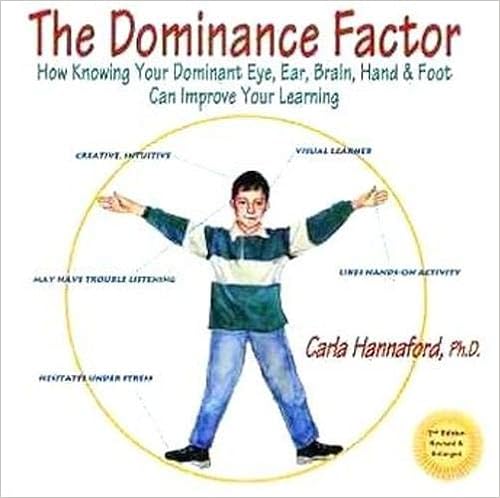
The Dominance Factor: How Knowing Your Dominant Eye, Ear, Brain, Hand & Foot Can Improve Your Learning, by Carla Hannaford (2011)
David's OT did a quick test to determine David's "profile", which seemed difficult because David, although he uses his right hand for writing, will use either hand for other fine motor activities, as well as throwing, and either foot for kicking. (Hannaford apparently didn't include ambidextrousness in her book.) David's OT photocopied two "profiles" which might fit him. I puzzled over them; nothing really seemed to make sense and included suspiciously pseudo-scientific language like:
emotional relevance to self
visual/kinesthetic learner must see the whole picture and physically do what is being learned
left eye scans from right to left [um, what? independently of the right eye?]
appreciates metaphors, examples and associations
when relaxed may preferentially listen for the details
must see the whole three-dimensional perspective and emotional elements to learn
I looked around online for research to support Therapeutic Listening. There's some provided on vitallinks.com, which of course will support the efficacy of the program. Ever since an OT friend told me that Brain Gym, a popular series of exercises purported to stimulate certain areas of the brain and improve overall function, was something a couple in California made up in the 1970s, with no basis in research, I've been a little leery of programs that are supposed to enhance or change a child's brain. Over the years, Brain Gym has been a big money maker, selling trainings, licenses, books, etc. Our school district follows Brain Gym religiously.
Here are some other dubious and debunked educational theories, some of which I've bought into myself as they've drifted through the school system in the form of educational fads and/or vague underpinnings of teaching approaches:
However, now with advances in brain research and imaging, the field of neurological education seems more feasible than it has in the past. We're going to go ahead and try Therapeutic Listening with David, based what we've read about the program (which includes before/after evaluation results on its website), encouraging anecdotal observations from David's OT, and David's own reaction after listening to the music through the special headphones for about 15 minutes. Chelsea asked him how he was doing, and he said, making eye contact with her, "I couldn't concentrate at first, but now I can."
Charles was a 14-year-old eighth grader who exhibited symptoms of autism. Charles’ mother was concerned about his poor social and motor skills. He also struggled with listening in noisy environments, which made listening to his teachers difficult and necessitated closed-captioning when watching television. His language was often hurried and mumbled, which made making friends difficult and created frustration for Charles.
After three months of Therapeutic Listening as therapy for these autism symptoms, Charles made significant improvements in auditory processing, which is seen in his scores of the SCAN-A. Charles’ perception of sound, particularly in complex auditory backgrounds, had improved dramatically. This in turn, was reflected in his ability to articulate his own speech more clearly. One weekend at the museum, Charles’ mother could clearly understand everything he said as he read the excerpts outside each exhibit. Since he was now able to discriminate spoken words efficiently and effectively, he no longer needed to use the closed-captioning during television shows. Furthermore, Charles was now more confident in his ability to communicate with his peers and was able to make new connections.
Charles’ improvements as a result of using Therapeutic Listening for his autism therapy can be seen in his scores on the Beery VMI. On the Motor Coordination subtest, Charles made a gain of one year and one month in three months’ time. His improvement in motor skills was reflected in his desire to participate in more athletic activities, whereas previously he was only interested in stationary activities such as drawing and watching television.
Listening is a function of the entire brain and goes well beyond stimulating the auditory system. It is a voluntary act. Active listening is dynamic and continually adapting. Listening requires the desire to communicate and the ability to focus the ear on certain sounds selected for discrimination and interpretation. An individual actively listens and directs attention to sounds in the environment with thewhole body.
Therapeutic Listening is a comprehensive, multi-faceted sound-based approach that involves much more than just the ears. Like other sensory systems, the auditory system does not work in isolation. Neurologically it is connected to all levels of brain function and as a result it has a vast range of influence. How we listen impacts not only our overall physiology, but also our behavior.
Therapeutic Listening is a specific sound-based intervention that is embedded in a developmental and sensory integration perspective. The music in Therapeutic Listening gives the listener unique and precisely controlled sensory information. The music is electronically modified to highlight the parts of the sound spectrum that naturally capture attention and activate body movement, synchronizing it with the environment. Therapeutic Listening uses electronic modifications, along with the organized, rhythmical sound patterns inherent in music, to trigger the self-organizing capacities of the nervous system.
Therapeutic Listening may benefit a wide variety of individuals of various ages who might exhibit:
poor attention
difficulties interacting with peers and limited play skills
challenges with transitions or changes in routine
difficulty communicating (both verbal and non-verbal)
struggles with sleep, bowel and bladder control, and eating
trouble following directions
challenges perceiving and navigating space
poor timing and sequencing of motor skills
difficulties with irritability, mood
difficulties with regulating their energy level (i.e. too low arousal or hyperactive)
postural insecurity (fear of heights, playing on playground equipment)
abnormal responses to various sensory stimuli (sounds, touch, taste, pain)
poor praxis and motor planning: coming up with an idea, planning, and completing the task
difficulty responding to sounds and verbal directions
Parents, teachers, and therapists have seen significant results by using Therapeutic Listening including: