Showing posts with label Social Studies. Show all posts

Tuesday, November 24, 2020

Self-Directed Science and Social Studies

David started a discussion with Eric about Chernobyl. They talked about the disaster, and how trees have grown up, and scientists go into the "ghost city" but only wild animals live there now.


Tuesday, November 17, 2020

Question of the Day

What's the difference between the House of Commons and Congress?

One might ponder this on a Tuesday morning after breakfast, in between thinking about how there aren't as many trees on the prairies (temperate grasslands), and reading about Indonesia in a world atlas.

Thursday, April 9, 2020

Request for Google

"Look up preemption traffic light," David tell me. OK, sure, why not. 

FYI:
A vehicle that uses a line-of-sight traffic signal preemption system is equipped with an emitter which typically sends a narrowly directed signal forward, towards traffic lights in front of the vehicle, in an attempt to obtain right-of-way through a controllable intersection prior to arrival.

Monday, April 17, 2017

Cultural Day

David waits to show his India display

Middle school and primary students come to see

Then the kids change into their costumes

Students listen to Mrs. T. and wait for parents and friends to arrive


David the snake charmer


Wednesday, March 29, 2017

Monday, April 18, 2016

Other Countries

David and his classmates

Jamaica, USA, Russia, Italy, Madagascar, Cuba, France, Japan, Sweden, Greenland, India, Thailand, Uganda, Costa Rica, Morocco, Antartica, Australia, Finland, Ireland, Netherlands, Mexico, Brazil, South Africa, Bermuda (and three not pictured - one is China, I can't remember the other two).

Presenting ... Sweden!

Smiling, waiting for the middle school kids.
(Mrs. Tabor told her students to smile.)

David answering questions


Display board by David
Photo of great-great-grandfather from Sweden
Swedish doll and Swedish horses from Grammie & Grampa
SAAB ornament, handkerchief from Mimi
and Swedish cookies baked by Mimi

Working on Sweden

Lots of cutting and pasting.


Wednesday, March 30, 2016

Cultural Day

Letter from teachers

Research

It would be wonderful if you could help your children learn some interesting facts about their country, and get a feel for the culture. First, visit your library and ask about good resources. Ideas to look up on YouTube and internet searches about your country are: music, indigenous people, sports, important buildings, religions, famous people, historical events, inventions, ancient history, and interesting animals or plants. Help them learn things that they can share with people when they come to look at their boards. Help them to get excited about their country.

Food

On Cultural Day, each student should bring a food from their country. This needs to be in two sections, one for our class sharing at lunch time (30 servings) and one for the after school Cultural Day event (30 or more servings). They will not be able to plug anything in and it needs to be easy to set up, preferably already cut into portions or put in small cups. (Think small hors d'oeuvres.) There are lots of countries being represented and each only needs to offer a taste. Please supply any cutlery, cups, or other items needed to sample the food. We will supply paper plates for parents/family/friends as they walk around during Cultural Day.

***During Cultural Day it will be expected that the students stay at their boards and present their information. This is why we will have a tasting of our own during lunch.

Costume & Actual Items

On Cultural Day, each student should bring or wear a costume from their country. Think about something that really shows the cultural flavor of their country. Most countries will have many costumes to explore, including historical and modern. Please don’t feel you have to buy anything. You can probably create a wonderful outfit from items around your house. Again, this is a great one to ask seasoned parents about if you need ideas.

On Cultural Day, you may also send in items from their country to set next to their boards. This could include money (in a zip lock bag), small statues, cloths, or other physical items to add a cultural flavor to their area. Space is somewhat limited, so nothing huge, please.


Please remember

This is a time for 1st through 6th grade to show their work. There will be many levels of proficiency and follow-through presented. It will be extra important to focus on individual encouragement. Help them to appreciate the work of others, while still feeling proud of their own work. Many students feel fondly about their chosen country for years. Is it going to be perfect? Of course not, but it can be something they will remember and be proud of for a long time.

Friday, March 18, 2016

Snakes and Lizards

David chose to sit at the table with the lizard cage this morning. The class has an anole lizard, named Obi-Wan Anole, which likes to bask in the light near the top of the cage, and a gecko, named Luke Skyhider, which hides under a log. (Kids in the class came up with the names.)

Obi-Wan Anole

David looked at the anole lizard a few times while he was working. Then, around 11:00, losing interest in his spelling work, he asked me where the gecko was. I lifted the lid carefully (lest the anole run up my sleeve) tipped up the log, and the gecko ran out. We watched him scuttle around the cage, hiding under things when he could.

Since David hadn't shown a lot of interest in the lizards before, aside from picking up crickets at the pet store for them to eat, I decided against trying to make him finish his spelling, and asked him if he wanted to look at a lizard book. He said he wanted to look at a book with snakes in it, and went and got a reptile book that he'd looked at another time. He looked at pictures of cobras and other snakes, and asked me to read about them. He looked at a drawing showing the sizes of different snakes and the prey they might eat.

"What about people?" he asked.

"Well, we don't have snakes like that here where we live, but in places where they do have snakes like that, like in Africa, people have ways of staying safe."

"Like what?"

"They can use a stick to hold the snake and move it away." David was very interested in this. I remembered a book that earlier in the school year Mrs. T. had read aloud from, in which a boy had encounters with snakes, with his uncle. David had not been engaged in the story when Mrs. T. was reading it, but I thought he might be now. I found the book and David looked at the pictures and asked me to read the parts that went along with them.

Akimbo waves goodbye to his father, and gets on a bus
to go visit his Uncle Peter, who owns a snake park

Uncle Peter uses a forked pole to capture a cobra
and milks the snake to collect its venom


A mamba escapes and Akimbo has to alert his uncle without getting bitten

David was caught up in the last part of the story, we both were, it was quite exciting and a little scary. He asked me to read the excerpts several times.


The lizard cage, the snake book, and Akimbo and the Snakes

The flexibility of the Montessori classroom allows students to follow an interest within the classroom and direct their own learning. It is amazing to me how much concentrated learning happens this way. 

Tuesday, March 15, 2016

Didgeridoo

Sometimes during work time Mrs. T. plays a CD. It's part of the Montessori curriculum to listen to and learn about different kinds of music. Earlier this school year the music really bothered David and he wanted to go out in the hall when it was on. Now he likes it and sometimes he thinks he's the DJ.

This morning Mrs. T. put on a CD of someone playing the didgeridoo. "What's that sound?" David asked. "It's a didgeridoo, a musical instrument from Australia," I told him. David wanted to know what the houses look like in Australia, so after he finished the work he was on we went to the school library and did a google search. Interior and exterior, of course.

This afternoon David picked out a DVD with the episode on it where Curious George and the Man with the Yellow Hat go to Australia, and he showed me the part where a character is playing the didgeridoo.

Friday, March 13, 2015

Observation of Lower Elementary Classroom

This morning, Eric took time off from work to stay home with David, while I went to school to observe the "lower el" classroom. Mrs. S. was subbing for Mrs. T. (the head teacher), and welcomed me with her usual friendliness, and a clipboard with the Guidelines for Observing (previous post). I sat in the observation chair, a rocking chair in one corner of the room, and had kind of a mini-vacation. No responsibilities, a comfortable seat, a sunny day.

The lower el classroom (grades 1-3) is very different from the primary classroom. It is, for the most part, quieter. I didn't hear any crying. There was a lot less whining, less running and falling, and I didn't see anyone hitting anyone else. I have thoroughly enjoyed being in Ms. Casey's classroom this year, watching her teach, and being involved in David's education, but it was a refreshing change to visit the lower el. Most of my teaching has been at the 3rd-4th grade level, with a couple of years in 5th-6th, and I felt very comfortable with the students in lower el. The student maturity level, social skills, and work ethic went far beyond what I had ever seen in the public school. It was eye-opening, interesting, and highly enjoyable. 

The spacious classroom has a center table, tables on walls under windows for independent or two person work, small group tables, and a floor table with a rug under it for students who want to sit on the floor or kneel. One corner had an area rug and a place to sit with pillows for reading or other work on the floor. As in primary, there is a math area, a science area, a language area, and a cultural area. Unlike primary, there are no practical life works, and there is a lot less work done on the floor. The students can opt to wear headphones to block classroom noise if they want to work quietly and independently. Like the primary classroom, the lower el has a bead cabinet:


metal insets for tracing shapes and making patterns:


globes, and a map cabinet:


The lower el also has flags from the nations of the world displayed on long shelf in the back of the room. Students can select a flag and trace and color it using a light box.


During my visit to the classroom, I saw students checking in with their teachers about work, and vice versa. I observed students talking about grammar work, spelling bees, doing reports on Antarctica (which I learned has a yearly population of 1,000-5,000), and India (which has three seasons: hot, cold, and rainy). I saw students constructing molecules with hands-on materials:
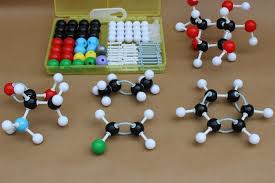
Image result for montessori building molecules science
Montessori materials for building molecules

Example of student work

I was turning around in my chair to observe the girls working .
"That's science," another student told me. "I already did that work."
"It looks interesting," I said.
"It is," she said. "You can turn your chair around if you want to."
"That's OK," I said. "I don't want to interrupt the girls that are working."

I noticed that the science shelves contain a periodic table (remember, this is first, second and third grade):


A second grader explained to me how the River Association came to their classroom and showed them how to find rodent skulls and bones in owl scat. (She said it didn't bother her because she has horses.)


I heard students arguing over volcano models they had made - "Don't touch it!" "I can touch mine." etc. This went on for some time without the students resolving their dispute.

Volcano models

Mrs. L. intervened, speaking to one student privately. The other students dispersed. Mrs. L. straightened the student's chair so she could sit back down, and said to her, "I'm feeling frustrated right now because I've asked you to do this work several times and you're still not doing it." Over the course of the morning I saw the teachers intervene several times, to redirect students. On the whole, students were very independent in solving problems, resolving disputes, working together and working independently. There was a natural flow to the activity in the room.

A student fed the classroom's beta fish, and observed it as it swam to the food and ate it.


Another student showed me the lizard, with the name Peek-a-Boo, hiding in the classroom terrarium.

The lizard is in the "tree"

Out in the hallway, there was a table in the corner where two girls were working quietly. Also, I had noticed students jumping up and down in the hall, so I looked to see what the activity was about. There are a number of movement cards, and an egg timer.

Self-directed physical education

I was also treated to tea and a snack during my visit. A friendly boy came up to me around 9:30 and asked if I wanted some tea. My first reaction was to say oh, no thank you, I'm fine, but then I remembered that taking the time to be gracious and hospitable is part of what a Montessori classroom teaches. I accepted, and he went back and forth, asking his teacher for help, asking me what flavor I wanted, and then bringing me the tea. "Be careful, it's hot," he said, and handed it to me carefully. Later, as he passed by my chair, I said, "Good tea. Thank you." He nodded politely and smiled. About an hour later, he asked me if I wanted something to eat. "We have salsa, chips, and extra cheddar cheese goldfish," he told me. "Chips and salsa, please," I told him. While I waited, a girl came up to me and asked if I would like a napkin, brought me one, then asked if I wanted a drink. The boy returned with the chips and salsa. Later, when my plate was empty, he checked back and asked politely if I was done, and took my plate and napkin. Wow!

Can you imagine that happening in a public school? And yet, isn't that a valuable skill for children to acquire: how to be genuinely courteous, polite, pleasant?

Friday, March 6, 2015

David's 100th Day of School

This week has been kind of rough. David and I were still somewhat sleep deprived from our trip to the city with Daddy and Grammie and Grampa. David was tired and didn't want to do any work at school. I kept selecting work for him, and it was like pulling teeth to get him to do it, sometimes.

Today, though, was completely different. David took his clipboard and said, "I'm looking to see what work I am going to do today." I almost fell over, I was so surprised. This is what was on the clipboard:

The Kindergarteners have work schedules now
Introduced last week

David went up to the sandpaper letters, pointed to the j, and said, "That's /j/." [phonetic sound]. I was surprised. I think David probably knows a lot of letter sounds. (In fact, I think David knows a lot that we don't know he knows.) We sat down and spelled a few words, then David put together some nonsense words for me to read, which he thoroughly enjoyed.

Then David said, "I'm tired because I need to do work."  (!!!) He went over to the bead cabinet. This is the bead work that David did today:


Map work, the continents. I picked this work out because three other boys nearby were working on maps. One of the boys was playing with the puzzle pieces, flying them around and making airplane and crashing sounds. I prompted David to fly one of his puzzle pieces over to the other boy's map. (OK, I know this isn't what a typical 1:1 aide would do, but what an ideal way to encourage peer interaction.) David flew his puzzle piece over, with sound effects, and the other boy laughed. The next time David did it, the boy said, "Go away." After 20 or 30 seconds, they were both back to work. (Just another typical Montessori classroom interaction.)


Word family work with the movable alphabet. David really enjoyed this -


A classmate came over to look at David's work. She showed us that she had just finished writing a story with a cat in it.

I realized yesterday that part of David's lack of interest in work was due to me selecting work that was too easy for him. Sometimes it's easy to assume where David's at. He's got a lot going on in his head.

He enjoys watching the younger children. He laughed and laughed watching a little boy play in the bathroom sink. He would look in the bathroom, laugh, and run away, then return to look again. Very entertaining.

David initiated a lot of peer interactions this week. There was a lot of back and forth conversation that I wasn't a part of at all. It was pretty great! I've been explaining a little bit to David about how to go up and talk to a peer, mostly things like, "Don't go up and put your face right next to another person's face. They might not like that. Just say, 'Hi,' or 'What are you doing?' David puts his own spin on it, of course:

......

"Excuse me! Excuse me!" David said to a classmate. "Where is T? Where is she?" (Asking about the classmate's sister, who was absent.)

"She's at home," said the classmate.


"Why is she at home? Why?"


"She's sick."


......


"Do you want to go for a ride, P? Do you want to go for a ride?"


"No, I don't," said P, "Because if you push me around in the rocking chair, the teacher is going to say, 'P, put the rocking chair back', and that's why I don't want to go for a ride."


Monday, February 2, 2015

Cave Houses

Today, David asked what cave houses look like on the inside. So we looked it up.


Source: Google search