Monday, January 31, 2022

Self-Directed Social Studies

"Is anyone descended from the Philistines?" David asked after I read the story of David and Goliath to him. After a Google Search we found out that the Philistines migrated from Greece to the area that is now Palestine. Then I found an article on nationalgeographic.com and read that to him:

Ancient DNA may reveal origin of the Philistines

Historical accounts and archaeology agree that the biggest villains of the Hebrew Bible were ‘different’—but how different were they really?

PUBLISHED JULY 3, 2019


The first-ever study of DNA recovered from an ancient Philistine site is providing a unique genetic insight into the origins of some of the most notorious troublemakers of the Old Testament.

The authors of the Hebrew Bible made it clear that the Philistines were not like them: This uncircumcised group is described in several passages as coming from the Land of Caphtor (modern-day Crete) before taking control of the coastal region of what is now southern Israel and the Gaza Strip. They warred with their Israelite neighbors, even seizing the Ark of the Covenant for a time. Their representatives in the Bible include the giant Goliath, who was felled by the future king David, and Delilah, who robbed the Israelite Samson of his strength by cutting his hair.

Modern archaeologists agree that the Philistines were different from their neighbors: Their arrival on the eastern shores of the Mediterranean in the early 12th century B.C. is marked by pottery with close parallels to the ancient Greek world, the use of an Aegean—instead of a Semitic—script, and the consumption of pork.

Many researchers also tie the presence of the Philistines to the exploits of the Sea Peoples, a mysterious confederation of tribes that, according to Egyptian and other historical sources, appears to have wreaked havoc across the eastern Mediterranean at the end of the Late Bronze Age in the 13th century and early 12th century B.C.

Now, a study published today in the journal Science Advances, prompted by the unprecedented 2016 discovery of a cemetery at the ancient Philistine city of Ashkelon on the southern coast of Israel, provides an intriguing look into the genetic origins and legacy of the Philistines. The research appears to support their foreign origin, but reveals that the reviled outsiders were soon marrying into the local populations.

The study analyzed DNA from ten sets of human remains recovered from Ashkelon across three different time periods: a Middle/Late Bronze Age burial ground (about 1650-1200 B.C.), which pre-dates the Philistine presence in the area; infant burials from the late 1100s B.C., following the arrival of the Philistines in the early Iron Age; and individuals buried in the Philistine cemetery in the later Iron Age (10th and ninth centuries B.C.)

The four early Iron Age DNA samples, all from infants buried beneath the floors of Philistine houses, include proportionally more “additional European ancestry” in their genetic signatures (roughly 14%) than in the pre-Philistine Bronze Age samples (2% to 9%), according to the researchers. While the origins of this additional “European ancestry” are not conclusive, the most plausible models point to Greece, Crete, Sardinia, and the Iberian peninsula.

What researchers find even more unusual is that this specific “European blip” disappears quickly and is statistically insignificant in the DNA from study samples recovered from the cemetery at Ashkelon only a few centuries after the infant burials. The later Philistine burials have genetic signatures very similar to local populations who lived in the region before the Philistines showed up.

“We managed to catch this movement of people coming to Ashkelon from southern Europe,” says Michal Feldman, an archaeogeneticist at the Max Planck Institute and study co-author. “Then it disappears very quickly within 200 years, probably because [the Philistines] intermarried and this kind of genetic signature was diluted within the local population.”

“For more than a century, we have debated the question of where the Philistines came from,” writes archaeologist Eric Cline in an email from his excavation at the Canaanite site of Tel Kabri (Cline was not involved in the current research.) “Now we have the answer: Southern Europe, and probably more specifically mainland Greece, Crete, or Sardinia. This fits with what had seemed the most likely answer previously, especially judging from [the archaeological remains], and so this seems a logical finding."

Despite the quick genetic assimilation that the Philistines underwent —they remained a distinct cultural group that was clearly identifiable from their neighbors for more than five centuries, until they were conquered by the Babylonians in 604 B.C.

Tuesday, January 25, 2022

Three Years Ago...


 ... this shirt was new. Now the writing has dissipated like cirrus clouds... and there are holes in it. Now David wears it to sleep in, he doesn't want to throw it out. (AND he's shaving now!)

And we thought THIS was weird...

Visit to the doctor's -
January 2019
pre-COVID

Wintertime's nice with the ice and snow...


Thursday, January 13, 2022

The Math Money Box


from Auntie

What is Different About OCD in Kids?

The symptoms of OCD are the same whether you are an adult or a child, but OCD in childhood can be more difficult to recognize for a variety of reasons.

Children may not recognize that what they are going through is out of the ordinary, and may not think to ask for help.

OCD in children can easily be mistaken for behavior and attention issues such as ADHD, especially when the symptoms interfere with schoolwork. To learn more about symptoms of OCD and anxiety at school, visit our Anxiety in the Classroom resource.

Kids and teens may also be more likely to involve family members in their compulsive behaviors and rituals. For example, a child may demand that his or her family join in lengthy washing rituals around mealtimes or may refuse to go to bed until a parent joins in a checking ritual.

When OCD begins in childhood, there is also a higher likelihood of the child having other disorders as well, such as tic disorders, attention deficit hyperactivity disorder (ADHD), and other anxiety disorders. Click here to learn more about co-occuring disorders.

Genetics may also play a larger role in OCD if it first appears earlier in childhood.


Source: International OCD Foundation

Medication for Pediatric OCD

The best treatment for pediatric OCD includes both medication and response prevention (ERP) therapy. Medication should only be considered when there are moderate to severe OCD symptoms.

If you child does not initially respond to ERP, your pediatrician or psychiatrist may decide to try medication to help manage symptoms and to potentially lower anxiety enough that your child can try ERP therapy again with more success.

The information provided below is meant for information only to help you make an informed decision together with a physician or psychiatrist experienced in treating OCD in kids and teens. Any decision to start or stop taking medication or change dosages should always be discussed with your prescribing physician.

When should medication be considered for children with OCD?

Both ERP and medication effectively treat OCD in children and adolescents. Their use is supported by the treatment guidelines of the American Psychiatric Association (APA) and the American Academy of Child and Adolescent Psychiatry (AACAP). Medications should only be considered when there are moderate to severe OCD symptoms and when exposure and response prevention (ERP) has not worked to treat symptoms.

What kind of medications can help treat OCD in children?

Antidepressants are usually the first kind of medication that a doctor will try. Your doctor might refer to these medications as “serotonin reuptake inhibitors” (SRIs).

SRIs include:

  • Citalopram (Celexa®)
  • Escitalopram (Lexapro®)
  • Fluvoxamine (Luvox®)
  • Fluoxetine (Prozac®)
  • Paroxetine (Paxil®)
  • Sertraline (Zoloft®)
  • Clomipramine (Anafranil®)

Will medication “cure” my child’s OCD?

OCD medications control and decrease symptoms, but do not “cure” the disorder. OCD is usually well controlled when proper treatment is in place. Symptoms often return when the child stops taking the medication, especially if he or she has not received ERP therapy.

How long does it take for OCD medications to work?

All OCD medications work slowly. It is important to not give up on a medication until it has been taken at the right dose for 10 to 12 weeks. Studies have also shown that improvement of childhood OCD can continue for at least a year after starting medication.

Are these medications approved for use in children?

Only four OCD medications have been approved by the United States Food and Drug Administration (FDA) for use in children: clomipramine (Anafranil®), fluoxetine (Prozac®), fluvoxamine (Luvox®) and sertraline (Zoloft®), but doctors can prescribe any OCD medications to children if they feel it is needed.

Source: International OCD Foundation

Therapy for OCD

It is possible that you may have heard of Cognitive Behavior Therapy (CBT) before. CBT refers to a group of similar types of therapies used by mental health therapists for treating psychological disorders, with the most important type of CBT for OCD being Exposure and Response Prevention (ERP).

The Exposure in ERP refers to exposing yourself to the thoughts, images, objects and situations that make you anxious and/or start your obsessions. While the Response Prevention part of ERP, refers to making a choice not to do a compulsive behavior once the anxiety or obsessions have been “triggered.” All of this is done under the guidance of a therapist at the beginning — though you will eventually learn to do your own ERP exercises to help manage your symptoms.

That said, this strategy of purposefully exposing yourself to things that make you anxious may not sound quite right to you. If you have OCD, you have probably tried to confront your obsessions and anxiety many times only to see your anxiety skyrocket. With ERP, the difference is that when you make the choice to confront your anxiety and obsessions you must also make a commitment to not give in and engage in the compulsive behavior. When you don’t do the compulsive behaviors, over time you will actually feel a drop in your anxiety level. This natural drop in anxiety that happens when you stay “exposed” and “prevent” the compulsive “response” is called habituation.

How is ERP different from traditional talk therapy (psychotherapy)?

Traditional talk therapy (or psychotherapy) tries to improve a psychological condition by helping the patient gain “insight” into their problems. Talk therapy can be a very valuable treatment for some disorders, but it has not been shown to be effective at treating the active symptoms of OCD.

While talk therapy may be of benefit at some point in a OCD patient’s recovery, it is important to try ERP or medication first, as these are the types of treatment that have been shown through extensive research to be the most effective for treating OCD.

Source: International OCD Foundation

What Causes OCD?

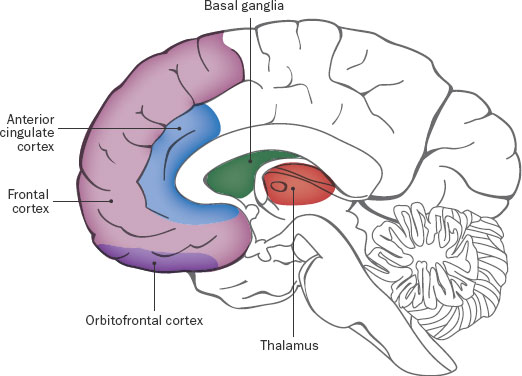
While we still do not know the exact cause or causes of OCD, research suggests that differences in the brain and genes of those affected may play a role.

Is OCD a Brain Disorder?

OCD Brain

Research suggests that OCD involves problems in communication between the front part of the brain and deeper structures of the brain. These brain structures use a neurotransmitter (basically, a chemical messenger) called serotonin. Pictures of the brain at work also show that, in some people, the brain circuits involved in OCD become more normal with either medications that affect serotonin levels (serotonin reuptake inhibitors, or SRIs) or cognitive behavior therapy (CBT).

Is OCD Inherited?

Research shows that OCD does run in families, and that genes likely play a role in the development of the disorder. Genes appear to be only partly responsible for causing the disorder, though. No one really knows what other factors might be involved, perhaps an illness or even ordinary life stresses that may induce the activity of genes associated with the symptoms of OCD.

Some experts think that OCD that begins in childhood may be different from the OCD that begins in adults. For example, a recent review of twin studies [1] has shown that genes play a larger role when OCD starts in childhood (45-65%) compared to when it starts in adulthood (27-47%).

Source: International OCD Foundation

Who gets OCD?

 OCD equally affects men, women, and children of all races, ethnicities, and backgrounds. 

At What Age Does OCD Appear?

OCD can start at any time from preschool to adulthood.

Although OCD can occur at any age, there are generally two age ranges when OCD tends to first appears:

  • Between the ages 8 and 12.
  • Between the late teen years and early adulthood.

How Many Adults Have OCD?

Our best estimates are that about 1 in 100 adults — or between 2 to 3 million adults in the United States — currently have OCD.

This is roughly the same number of people living in the city of Houston, Texas.

How Many Children Have OCD?

There are  at least 1 in 200 – or 500,000 – kids and teens that have OCD. This is about the same number of kids who have diabetes.

Source: International OCD Foundation

Common Compulsions in OCD

 Washing and Cleaning

  • Washing hands excessively or in a certain way
  • Excessive showering, bathing, tooth-brushing, grooming routines
  • Cleaning household items or other objects excessively

Checking

  • Checking that you did not/will not harm others
  • Checking that you did not/will not harm yourself
  • Checking that nothing terrible happened
  • Checking that you did not make a mistake

Repeating

  • Rereading or rewriting
  • Repeating routine activities (examples: going in or out doors, getting up or down from chairs)
  • Repeating body movements (example: tapping, touching, blinking)
  • Repeating activities in “multiples” (examples: doing a task three times because three is a “good,” “right,” “safe” number)

Mental Compulsions

  • Mental review of events to prevent harm (to oneself others, to prevent terrible consequences)
  • Counting while performing a task to end on a “good,” “right,” or “safe” number
  • “Cancelling” or “Undoing” (example: replacing a “bad” word with a “good” word to cancel it out)

Other Compulsions

  • Putting things in order or arranging things until it “feels right”
  • Telling, asking or confessing to get reassurance
  • Avoiding situations that might trigger your obsessions

Source: International OCD Foundation

What are compulsions?

Compulsions are the second part of obsessive compulsive disorder. These are repetitive behaviors or thoughts that a person uses with the intention of neutralizing, counteracting, or making their obsessions go away. People with OCD realize this is only a temporary solution but without a better way to cope they rely on the compulsion as a temporary escape. Compulsions can also include avoiding situations that trigger obsessions. Compulsions are time consuming and get in the way of important activities the person values.

Similar to obsessions, not all repetitive behaviors or “rituals” are compulsions.  You have to look at the function and the context of the behavior. For example, bedtime routines, religious practices, and learning a new skill all involve some level of repeating an activity over and over again, but are usually a positive and functional part of daily life. Behaviors depend on the context. Arranging and ordering books for eight hours a day isn’t a compulsion if the person works in a library. Similarly, you may have “compulsive” behaviors that wouldn’t fall under OCD, if you are just a stickler for details or like to have things neatly arranged. In this case, “compulsive” refers to a personality trait or something about yourself that you actually prefer or like. In most cases, individuals with OCD feel driven to engage in compulsive behavior and would rather not have to do these time consuming and many times torturous acts. In OCD, compulsive behavior is done with the intention of trying to escape or reduce anxiety or the presence of obsessions.

Source: International OCD Foundation

Common Obsessions in OCD

 Contamination

  • Germs/disease
  • Environmental contaminants (examples: asbestos, radiation)
  • Household chemicals (examples: cleaners, solvents)

Losing Control

  • Fear of acting on an impulse to harm oneself
  • Fear of acting on an impulse to harm others
  • Fear of blurting out obscenities or insults
  • Fear of stealing things

Harm

  • Fear of being responsible for something terrible happening (examples: fire, burglary)
  • Fear of harming others because of not being careful enough (example: dropping something on the ground that might cause someone to slip and hurt him/herself)

Obsessions Related to Perfectionism

  • Concern about evenness or exactness
  • Concern with a need to know or remember
  • Fear of losing things

Religious Obsessions (Scrupulosity)

  • Concern with offending God
  • Excessive concern with right/wrong or morality

Other Obsessions

  • Concern with getting a physical illness or disease
  • Superstitious ideas about lucky/unlucky numbers, certain colors

What exactly are obsessions?

Obsessions are thoughts, images or impulses that occur over and over again and feel outside of the person’s control. Individuals with OCD do not want to have these thoughts and find them disturbing. In most cases, people with OCD realize that these thoughts don’t make any sense. Obsessions are typically accompanied by intense and uncomfortable feelings such as fear, disgust, doubt, or a feeling that things have to be done in a way that is “just right.” In the context of OCD, obsessions are time consuming and get in the way of important activities the person values. This last part is extremely important to keep in mind as it, in part, determines whether someone has OCD — a psychological disorder — rather than an obsessive personality trait.

Unfortunately, “obsessing” or “being obsessed” are commonly used terms in every day language. These more casual uses of the word means that someone is preoccupied with a topic or an idea or even a person. “Obsessed” in this everyday sense doesn’t involve problems in day-to-day living and even has a pleasurable component to it. You can be “obsessed” with a new song you hear on the radio, but you can still meet your friend for dinner, get ready for bed in a timely way, get to work on time in the morning, etc., despite this obsession. In fact, individuals with OCD have a hard time hearing this usage of “obsession” as it feels as though it diminishes their struggle with OCD symptoms.

Even if the content of the “obsession” is more serious, for example, everyone might have had a thought from time to time about getting sick, or worrying about a loved one’s safety, or wondering if a mistake they made might be catastrophic in some way, that doesn’t mean these obsessions are necessarily symptoms of OCD. While these thoughts look the same as what you would see in OCD, someone without OCD may have these thoughts, be momentarily concerned, and then move on. In fact, research has shown that most people have unwanted “intrusive thoughts” from time to time, but in the context of OCD, these intrusive thoughts come frequently and trigger extreme anxiety that gets in the way of day-to-day functioning.

Source: International OCD Foundation

What is OCD?

Obsessive compulsive disorder (OCD) is a mental health disorder that affects people of all ages and walks of life, and occurs when a person gets caught in a cycle of obsessions and compulsions. Obsessions are unwanted, intrusive thoughts, images, or urges that trigger intensely distressing feelings. Compulsions are behaviors an individual engages in to attempt to get rid of the obsessions and/or decrease his or her distress.

Most people have obsessive thoughts and/or compulsive behaviors at some point in their lives, but that does not mean that we all have “some OCD.” In order for a diagnosis of obsessive compulsive disorder to be made, this cycle of obsessions and compulsions becomes so extreme that it consumes a lot of time and gets in the way of important activities that the person values.

Source: International OCD Foundation

The Lake at Mimi's Froze Over

Wednesday, January 12, 2022

UAB Hospital delivers record-breaking premature baby

I have a friend who was a preemie; David was asking about it so we looked it up and watched this video.
Curtis Means was born at 21 weeks and one day.

Guinness World Records – The most premature baby to survive is Curtis Means (U.S.A.) who was born to Michelle Butler on 5 July 2020 at the University of Alabama at Birmingham Hospital in Alabama, U.S.A. at a gestational age of 21 weeks 1 day or 148 days, making him 132 days premature.

Wednesday, January 5, 2022

North American Biomes


After David finished the worksheet he decided to go outside and collect some samples of coniferous and deciduous leaves.

Virtual Math Set-up

math time with Mr. Pettee

"That's right!" 

"That's correct!"

(David imitates Mr. Pettee's voice.)