David brings home a report every day about his schedule, work finished, comments. Here are the reports from this week:
Monday
8:30 Arrival / breakfast
9:00 Morning Meeting in 3rd grade classroom
9:30 Literacy
10:00 Writing - Sir Isaac Newton - Difficulty focusing on writing
10:30 OT - After OT was ready to do his writing
11:00 Lunch
11:30 Recess - went outside for a short time
12:00 Mail / Math
12:30 Weather chart / weather radar - was noticeably preoccupied w/the brightness outside; often shielding his eyes with his hand
1:00 Science - Sir Isaac Newton - VERY interested in Newton videos
- rainbow science
1:30 Mystery Doug
2:00 Dismissal
Tuesday
8:30 Arrival / breakfast
9:00 Morning Meeting / Read aloud - Making maple syrup / played 7-up
9:30 Literacy - worked hard
10:00 Writing - worked hard
11:00 Lunch / Read aloud
11:30 Recess
12:00 PT
12:30 Mail / Math
1:00 Weather / Science - Newton reading - weather video
2:00 Dismissal
Wednesday
8:30 Arrival / breakfast
9:00 Morning Meeting - played Zip, Zap, Pop
9:30 Community trip to Dollar Tree and grocery store - helped with grocery shopping
11:00 Lunch
11:30 Recess
12:00 RAZ Kids
12:30 Mail / Math
1:00 Weather / Walk
1:30 Science - "Today, I have a video in mind. I want to look up weather themomena [phenomena]." He was quite serious.
2:00 Dismissal
Thursday
8:30 Arrival / breakfast
9:00 Morning meeting - played 4 corners / Read aloud
9:30 Library / Literacy
10:00 Writing - worked hard
10:30 RAZ Kids
11:00 Lunch
11:30 Recess
12:00 Mail / Math
12:30 Weather / Choices game (social situations)
1:00 Science
2:00 Dismissal
Friday
8:30 Speech
9:30 Field Trip to Children's Museum
12:00 Mail / Math - able to catch on faster than other days
1:00 Weather / Science / Walk
2:00 Dismissal
Saturday, March 24, 2018

Wednesday, March 21, 2018
Hooray for Eugie!
 |
| Eugie, almost a big one-year-old! |
The other morning, David was walking around the house chanting, "Hooray for Eugie! Hooray for Eugie! Hooray for Eugie!"
He has plans to sit with Eugie in our recliner. After he shows her the new carpet.
Email from a friend
My friend Esther send me this email after I sent her the elevator pictures. (She watched David for us at church one morning while Eric and I were at a class there.)
Hi Susan,
Thanks for the pictures! I really enjoyed watching David! And I would have made Elsa come if I had realised how much he wanted the girls there!
But, I got the chance to talk to him as I never really have before, and it was delightful! He told me about the new carpet going in on Monday and how it would be done when he got home from school and how the cats would be staying in another room during the work because the workers would be loud and might scare them. Then he told me about the weather and how we were having an arctic breeze (not the word he used) but what we needed was a tropical breeze. I told him I couldn't agree more! Then he told me how you might move your kitchen to the laundry room. and move the laundry room to the kitchen. He said that there is a 1% chance that you will do this. Then he upped it to a 6% .
He is such a sweet precious boy! You are doing such a good job with him! Thank you for giving me the privilege of watching him!


Progress Report
Individual Education Program (IEP) 6/6/17-6/5/18
Social Skills - Goal Met
Goal/Outcome: By 6/5/18, given direct social skills instruction, social stories, prompting, and supportive opportunities to practice, David will initiate play with peers appropriately 8 out of 10 opportunities observed, as measured by daily data collection.
Comments: During recess David appropriately initiates play with peers. He typically prefers to race and talk to adults, but when prompted will ask other students to race around the track. With so much snow play options are limited but he is appropriate with peers, and has not interfered with their play (taking their items and running) in any way. During inside play opportunities he has played games, or showed interest in playing too. He recently has been interested in playing with trucks, he will follow the "unwritten rules" that other children have implemented during play.
Reading - Goal Met
Goal/Outcome: By 6/5/18, given individualized direct instruction, visuals, phonics instruction, supportive opportunities to practice, faded prompting and support, David will increase his independent reading fluency and comprehension skill level from an end 1st grade (lexile, DRA, F&P, Common Core aligned) skill level to a mid 2nd grade skill level with 95% accuracy, as measured by formal and informal reading assessments.
Comments: David is currently reading at a level L (mid second grade) instructionally with 90% accuracy. He comments that this reading level is more difficult, but is working on decoding words with 2-3 syllables, using more in depth decoding strategies, and understanding word patterns, such as consonant clusters, vowel teams, and inflectional endings. He is reading level L with great comprehension, and enjoys writing about the books he reads.
Phonics - Adequate Progress
Goal/Outcome: By 6/5/18, given individualized direct instruction, supportive opportunities to practice, manipulatives and multi-sensory instruction, David will decode words with initial consonant clusters, and medial vowels with long and short sounds with 90% accuracy, as measured by teacher created assessments, formal assessments, and running records.
Comments: David is currently working on decoding medial vowels, beginning consonant clusters, and we have newly added inflectional endings and vowel teams. He is able to decode vowel (long & short) with more success in isolation. When reading in context he has a trickier time, but with visual/verbal prompts. He will go back and re-read when he knows something is incorrect, if he can't get it he gets frustrated, but with prompting will correct.
Mathematics - Goal Met
Goal/Outcome: By 6/5/18, given individualized direct instruction, manipulatives, visual supports, and multi-sensory instruction, David will increase his mathematics skills from an end 1st grade level to a mid 2nd grade level with 90% accuracy, as measured by formal and informal mathematics assessments and students work samples.
Comments: David has made great progress in the area of mathematics. He has met his 1st grade math standards, and has moved on to working on 2nd grade standards. He is currently working on end of 2nd grade standards, and focusing on more concrete functional skills like measuring, money and time.
Writing - Adequate Progress
Goal/Outcome: By 6/5/18, given individualized direct instruction, graphic organizers, visual prompts and supportive opportunities to practice, David will produce narrative writing pieces with a beginning, middle with details, and an end, using temporal words, as measured by writing samples, writing rubrics and assessments.
Comments: David has beautiful handwriting, and can compose writing pieces with beginning, middle and end. He does not like to write personal narratives, he prefers to write in response to a reading, or writing non-fiction about his specific interests. He has a writing board at school to display his writing, that he is very proud of, and that motivates him to work hard and produce his best writing.
Monday, March 19, 2018
Elevator Ride
David was excited to take an elevator ride with Finley and his mom. The church we go to put in an elevator so Finley could access the lower level in his wheelchair, so he can go to Sunday school with the other kids.

The elevator was expensive to purchase and install. The church wasn't required by law to put it in, but they wanted to do it to include Finley as part of the church family in the activities downstairs.
Finley is unable to walk, speak, eat or drink (he is fed by a feeding tube twice a day), or in any way take care of himself. He can't sit up or support his own weight. But he has the sweetest spirit - when someone lean down to talk to him, he swings his head slightly and moves his eyes towards them, smiles and makes a sound with his voice, like, "Uh!" or sometimes even "Hi!" His mom, Esther, cares for him faithfully and lovingly every day. She said that her attitude has changed over the years, from feeling like Finley is a burden, to feeling privileged and blessed to take care of him.
Esther and I got to be friends when David was 2 and Finley was 3, when we took the boys to Lynn's OT toddler play group. That was 8 years ago now!
 |
| David presses the button to run the elevator |

The elevator was expensive to purchase and install. The church wasn't required by law to put it in, but they wanted to do it to include Finley as part of the church family in the activities downstairs.
Finley is unable to walk, speak, eat or drink (he is fed by a feeding tube twice a day), or in any way take care of himself. He can't sit up or support his own weight. But he has the sweetest spirit - when someone lean down to talk to him, he swings his head slightly and moves his eyes towards them, smiles and makes a sound with his voice, like, "Uh!" or sometimes even "Hi!" His mom, Esther, cares for him faithfully and lovingly every day. She said that her attitude has changed over the years, from feeling like Finley is a burden, to feeling privileged and blessed to take care of him.
Esther and I got to be friends when David was 2 and Finley was 3, when we took the boys to Lynn's OT toddler play group. That was 8 years ago now!
How Does God View Disability?
But God has chosen the foolish things of the world to put to shame the wise, and God has chosen the weak things of the world to put to shame the things which are mighty; and the base things of the world and the things which are despised God has chosen, and the things which are not, to bring to nothing the things that are, that no flesh should glory in His presence.
- 1 Cor 1:26-29
- Luke 14:12-14
Wednesday, March 14, 2018
Immoral
from BBC News Ouch Blog
August 2014
Richard Dawkins, the atheist writer, has caused a stir on Twitter claiming it is "immoral" to allow unborn babies with Down's syndrome to live. But what do the relatives of people with Down's syndrome think about the comments?
The Oxford professor posted the message on Twitter in response to a user who wrote she would be faced with "a real ethical dilemma" if she became pregnant and learned that the baby would be born with Down's syndrome.
"Abort it and try again," Dawkins tweeted in reply. "It would be immoral to bring it into the world if you have the choice."
His comments have caused anger online and have been dismissed by charities, but he insists his views are "very civilised", tweeting: "These are fetuses, diagnosed before they have human feelings."
For Caroline White, whose son Seb has Down's syndrome, the comments are offensive. "What saddens me most and what can't be denied is he backs up his argument by saying it's what the 'majority of women' do anyway," she says. "Yes, it is. It's what most women do. Women who, like him, like me, most probably grew up in a time of exclusion. A time where disabled people and people with Down's were labelled and then hidden away, never given the chance to integrate, reach their full potential or form meaningful relationships with their wider community."
Dawkins defended his comments on the social media website saying: "I do not for one moment apologise for approaching moral philosophic questions in a logical way. There's a place for emotion & this isn't it."
Tuesday, March 13, 2018
Disappearing Down: Iceland's Ethical Dilemma
"What kind of society do you want to live in?":
Inside the country where Down syndrome is disappearing
With the rise of prenatal screening tests across Europe and the United States, the number of babies born with Down syndrome has significantly decreased, but few countries have come as close to eradicating Down syndrome births as Iceland.
Since prenatal screening tests were introduced in Iceland in the early 2000s, the vast majority of women -- close to 100 percent -- who received a positive test for Down syndrome terminated their pregnancy.
While the tests are optional, the government states that all expectant mothers must be informed about availability of screening tests, which reveal the likelihood of a child being born with Down syndrome. Around 80 to 85 percent of pregnant women choose to take the prenatal screening test, according to Landspitali University Hospital in Reykjavik.
"CBSN: On Assignment" headed to Iceland with CBS News correspondent Elaine Quijano to investigate what's factoring into the high termination rates.
Using an ultrasound, blood test and the mother's age, the test, called the Combination Test, determines whether the fetus will have a chromosome abnormality, the most common of which results in Down syndrome. Children born with this genetic disorder have distinctive facial issues and a range of developmental issues. Many people born with Down syndrome can live full, healthy lives, with an average lifespan of around 60 years.
Other countries aren't lagging too far behind in Down syndrome termination rates. According to the most recent data available, the United States has an estimated termination rate for Down syndrome of 67 percent (1995-2011); in France it's 77 percent (2015); and Denmark, 98 percent (2015). The law in Iceland permits abortion after 16 weeks if the fetus has a deformity -- and Down syndrome is included in this category.
With a population of around 330,000, Iceland has on average just one or two children born with Down syndrome per year, sometimes after their parents received inaccurate test results. (In the U.S., according to the National Down Syndrome Society, about 6,000 babies with Down syndrome are born each year.)
"Babies with Down syndrome are still being born in Iceland," said Hulda Hjartardottir, head of the Prenatal Diagnosis Unit at Landspitali University Hospital, where around 70 percent of Icelandic children are born. "Some of them were low risk in our screening test, so we didn't find them in our screening."
When Thordis Ingadottir was pregnant with her third child at the age of 40, she took the screening test. The results showed her chances of having a child with Down syndrome were very slim, odds of 1 in 1,600. However, the screening test is only 85 percent accurate. That year, 2009, three babies were born with Down syndrome in Iceland, including Ingadottir's daughter Agusta, who is now 7.
According to Ingadottir, three babies born with Down syndrome is "quite more than usual. Normally there are two, in the last few years." Since the birth of her daughter, Ingadottir has become an activist for the rights of people with Down syndrome.
As Agusta grows up, "I will hope that she will be fully integrated on her own terms in this society. That's my dream," Ingadottir said. "Isn't that the basic needs of life? What kind of society do you want to live in?"
Geneticist Kari Stefansson is the founder of deCODE Genetics, a company that has studied nearly the entire Icelandic population's genomes. He has a unique perspective on the advancement of medical technology. "My understanding is that we have basically eradicated, almost, Down syndrome from our society -- that there is hardly ever a child with Down syndrome in Iceland anymore," he said.
Quijano asked Stefansson, "What does the 100 percent termination rate, you think, reflect about Icelandic society?"
"It reflects a relatively heavy-handed genetic counseling," he said. "And I don't think that heavy-handed genetic counseling is desirable. … You're having impact on decisions that are not medical, in a way."
Stefansson noted, "I don't think there's anything wrong with aspiring to have healthy children, but how far we should go in seeking those goals is a fairly complicated decision."
According to Hjartardottir, "We try to do as neutral counseling as possible, but some people would say that just offering the test is pointing you towards a certain direction." Indeed, more than 4 out of 5 pregnant women in Iceland opt for the prenatal screening test.
For expectant mother Bergthori Einarsdottir, who chose to have the test, knowing that most women did so helped steer her decision. "It was not pressure, but they told me that most women did it," she said. "It did affect me maybe a little bit."
Over at Landspitali University Hospital, Helga Sol Olafsdottir counsels women who have a pregnancy with a chromosomal abnormality. They speak to her when deciding whether to continue or end their pregnancies. Olafsdottir tells women who are wrestling with the decision or feelings of guilt: "This is your life — you have the right to choose how your life will look like."
She showed Quijano a prayer card inscribed with the date and tiny footprints of a fetus that was terminated.
Quijano noted, "In America, I think some people would be confused about people calling this 'our child,' saying a prayer or saying goodbye or having a priest come in -- because to them abortion is murder."
Olafsdottir responded, "We don't look at abortion as a murder. We look at it as a thing that we ended. We ended a possible life that may have had a huge complication... preventing suffering for the child and for the family. And I think that is more right than seeing it as a murder -- that's so black and white. Life isn't black and white. Life is grey."
Aug. 2017
With the rise of prenatal screening tests across Europe and the United States, the number of babies born with Down syndrome has significantly decreased, but few countries have come as close to eradicating Down syndrome births as Iceland.
Since prenatal screening tests were introduced in Iceland in the early 2000s, the vast majority of women -- close to 100 percent -- who received a positive test for Down syndrome terminated their pregnancy.
While the tests are optional, the government states that all expectant mothers must be informed about availability of screening tests, which reveal the likelihood of a child being born with Down syndrome. Around 80 to 85 percent of pregnant women choose to take the prenatal screening test, according to Landspitali University Hospital in Reykjavik.
"CBSN: On Assignment" headed to Iceland with CBS News correspondent Elaine Quijano to investigate what's factoring into the high termination rates.
Using an ultrasound, blood test and the mother's age, the test, called the Combination Test, determines whether the fetus will have a chromosome abnormality, the most common of which results in Down syndrome. Children born with this genetic disorder have distinctive facial issues and a range of developmental issues. Many people born with Down syndrome can live full, healthy lives, with an average lifespan of around 60 years.
Other countries aren't lagging too far behind in Down syndrome termination rates. According to the most recent data available, the United States has an estimated termination rate for Down syndrome of 67 percent (1995-2011); in France it's 77 percent (2015); and Denmark, 98 percent (2015). The law in Iceland permits abortion after 16 weeks if the fetus has a deformity -- and Down syndrome is included in this category.
With a population of around 330,000, Iceland has on average just one or two children born with Down syndrome per year, sometimes after their parents received inaccurate test results. (In the U.S., according to the National Down Syndrome Society, about 6,000 babies with Down syndrome are born each year.)
"Babies with Down syndrome are still being born in Iceland," said Hulda Hjartardottir, head of the Prenatal Diagnosis Unit at Landspitali University Hospital, where around 70 percent of Icelandic children are born. "Some of them were low risk in our screening test, so we didn't find them in our screening."
When Thordis Ingadottir was pregnant with her third child at the age of 40, she took the screening test. The results showed her chances of having a child with Down syndrome were very slim, odds of 1 in 1,600. However, the screening test is only 85 percent accurate. That year, 2009, three babies were born with Down syndrome in Iceland, including Ingadottir's daughter Agusta, who is now 7.
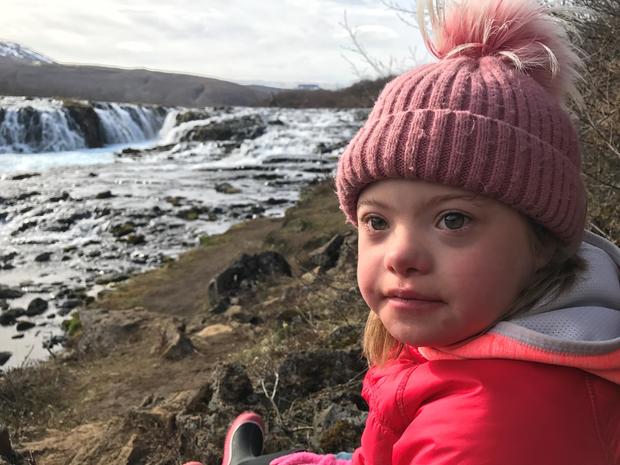 |
| Agusta, age 7. On average, Iceland has two people with Down syndrome born each year. |
As Agusta grows up, "I will hope that she will be fully integrated on her own terms in this society. That's my dream," Ingadottir said. "Isn't that the basic needs of life? What kind of society do you want to live in?"
Geneticist Kari Stefansson is the founder of deCODE Genetics, a company that has studied nearly the entire Icelandic population's genomes. He has a unique perspective on the advancement of medical technology. "My understanding is that we have basically eradicated, almost, Down syndrome from our society -- that there is hardly ever a child with Down syndrome in Iceland anymore," he said.
Quijano asked Stefansson, "What does the 100 percent termination rate, you think, reflect about Icelandic society?"
"It reflects a relatively heavy-handed genetic counseling," he said. "And I don't think that heavy-handed genetic counseling is desirable. … You're having impact on decisions that are not medical, in a way."
Stefansson noted, "I don't think there's anything wrong with aspiring to have healthy children, but how far we should go in seeking those goals is a fairly complicated decision."
According to Hjartardottir, "We try to do as neutral counseling as possible, but some people would say that just offering the test is pointing you towards a certain direction." Indeed, more than 4 out of 5 pregnant women in Iceland opt for the prenatal screening test.
For expectant mother Bergthori Einarsdottir, who chose to have the test, knowing that most women did so helped steer her decision. "It was not pressure, but they told me that most women did it," she said. "It did affect me maybe a little bit."
Over at Landspitali University Hospital, Helga Sol Olafsdottir counsels women who have a pregnancy with a chromosomal abnormality. They speak to her when deciding whether to continue or end their pregnancies. Olafsdottir tells women who are wrestling with the decision or feelings of guilt: "This is your life — you have the right to choose how your life will look like."
She showed Quijano a prayer card inscribed with the date and tiny footprints of a fetus that was terminated.
Quijano noted, "In America, I think some people would be confused about people calling this 'our child,' saying a prayer or saying goodbye or having a priest come in -- because to them abortion is murder."
Olafsdottir responded, "We don't look at abortion as a murder. We look at it as a thing that we ended. We ended a possible life that may have had a huge complication... preventing suffering for the child and for the family. And I think that is more right than seeing it as a murder -- that's so black and white. Life isn't black and white. Life is grey."
Monday, March 12, 2018
Gerber Baby
Feb. 2018

The 2018 Gerber baby was just named, and he is Lucas Warren, the first child with Down syndrome to receive the honor of, essentially, America’s cutest baby.
The 18-month-old from Dalton, Ga., was selected as “2018 Gerber Spokesbaby” from more than 140,000 photos submitted by parents.

It was Lucas’s smile that won him the iconic contest, said Bill Partyka, chief executive and president of Gerber
“Every year, we choose the baby who best exemplifies Gerber’s long-standing heritage of recognizing that every baby is a Gerber baby,” Partyka said. “This year, Lucas is the perfect fit.”

Other parents, especially those who have children with Down syndrome, celebrated.
“In a puddle of tears over here…my mama heart is so so thankful…when Bodie was born I believed a lie, that others would not value him as much as I do. But, today is a new day. It is such a beautiful, good day,” wrote samanthajob on Instagram.
Instagram user nicki_bloms wrote: “As a mama currently carrying a cutie with an extra chromosome this made my day!!! Thank you Gerber!! ”
Lucas’s mother said she was totally floored that Lucas won. She has heard from people all over the world who are congratulating Lucas, and telling her that his smile is warming a lot of hearts.
“We know Gerber chose him because of his cuteness, but it also is spreading awareness of acceptance of people with disabilities of all kinds,” she said. “No matter if we have a disability or not, we’re all just humans.”
Cortney Warren said she is excited for the honor, but she wants her son to be recognized as the funny, outgoing, music-loving child he is. He is the kind of kid, she said, who senses if someone is upset, and will go over and deliver “a big, old sloppy kiss.”
“He may have Down syndrome, but he’s always Lucas first,” she said.


Subscribe to:
Posts (Atom)