Monday, January 31, 2022

Self-Directed Social Studies

"Is anyone descended from the Philistines?" David asked after I read the story of David and Goliath to him. After a Google Search we found out that the Philistines migrated from Greece to the area that is now Palestine. Then I found an article on nationalgeographic.com and read that to him:

Ancient DNA may reveal origin of the Philistines

Historical accounts and archaeology agree that the biggest villains of the Hebrew Bible were ‘different’—but how different were they really?

PUBLISHED JULY 3, 2019


The first-ever study of DNA recovered from an ancient Philistine site is providing a unique genetic insight into the origins of some of the most notorious troublemakers of the Old Testament.

The authors of the Hebrew Bible made it clear that the Philistines were not like them: This uncircumcised group is described in several passages as coming from the Land of Caphtor (modern-day Crete) before taking control of the coastal region of what is now southern Israel and the Gaza Strip. They warred with their Israelite neighbors, even seizing the Ark of the Covenant for a time. Their representatives in the Bible include the giant Goliath, who was felled by the future king David, and Delilah, who robbed the Israelite Samson of his strength by cutting his hair.

Modern archaeologists agree that the Philistines were different from their neighbors: Their arrival on the eastern shores of the Mediterranean in the early 12th century B.C. is marked by pottery with close parallels to the ancient Greek world, the use of an Aegean—instead of a Semitic—script, and the consumption of pork.

Many researchers also tie the presence of the Philistines to the exploits of the Sea Peoples, a mysterious confederation of tribes that, according to Egyptian and other historical sources, appears to have wreaked havoc across the eastern Mediterranean at the end of the Late Bronze Age in the 13th century and early 12th century B.C.

Now, a study published today in the journal Science Advances, prompted by the unprecedented 2016 discovery of a cemetery at the ancient Philistine city of Ashkelon on the southern coast of Israel, provides an intriguing look into the genetic origins and legacy of the Philistines. The research appears to support their foreign origin, but reveals that the reviled outsiders were soon marrying into the local populations.

The study analyzed DNA from ten sets of human remains recovered from Ashkelon across three different time periods: a Middle/Late Bronze Age burial ground (about 1650-1200 B.C.), which pre-dates the Philistine presence in the area; infant burials from the late 1100s B.C., following the arrival of the Philistines in the early Iron Age; and individuals buried in the Philistine cemetery in the later Iron Age (10th and ninth centuries B.C.)

The four early Iron Age DNA samples, all from infants buried beneath the floors of Philistine houses, include proportionally more “additional European ancestry” in their genetic signatures (roughly 14%) than in the pre-Philistine Bronze Age samples (2% to 9%), according to the researchers. While the origins of this additional “European ancestry” are not conclusive, the most plausible models point to Greece, Crete, Sardinia, and the Iberian peninsula.

What researchers find even more unusual is that this specific “European blip” disappears quickly and is statistically insignificant in the DNA from study samples recovered from the cemetery at Ashkelon only a few centuries after the infant burials. The later Philistine burials have genetic signatures very similar to local populations who lived in the region before the Philistines showed up.

“We managed to catch this movement of people coming to Ashkelon from southern Europe,” says Michal Feldman, an archaeogeneticist at the Max Planck Institute and study co-author. “Then it disappears very quickly within 200 years, probably because [the Philistines] intermarried and this kind of genetic signature was diluted within the local population.”

“For more than a century, we have debated the question of where the Philistines came from,” writes archaeologist Eric Cline in an email from his excavation at the Canaanite site of Tel Kabri (Cline was not involved in the current research.) “Now we have the answer: Southern Europe, and probably more specifically mainland Greece, Crete, or Sardinia. This fits with what had seemed the most likely answer previously, especially judging from [the archaeological remains], and so this seems a logical finding."

Despite the quick genetic assimilation that the Philistines underwent —they remained a distinct cultural group that was clearly identifiable from their neighbors for more than five centuries, until they were conquered by the Babylonians in 604 B.C.

Tuesday, January 25, 2022

Three Years Ago...


 ... this shirt was new. Now the writing has dissipated like cirrus clouds... and there are holes in it. Now David wears it to sleep in, he doesn't want to throw it out. (AND he's shaving now!)

And we thought THIS was weird...

Visit to the doctor's -
January 2019
pre-COVID

Wintertime's nice with the ice and snow...


Thursday, January 13, 2022

The Math Money Box


from Auntie

What is Different About OCD in Kids?

The symptoms of OCD are the same whether you are an adult or a child, but OCD in childhood can be more difficult to recognize for a variety of reasons.

Children may not recognize that what they are going through is out of the ordinary, and may not think to ask for help.

OCD in children can easily be mistaken for behavior and attention issues such as ADHD, especially when the symptoms interfere with schoolwork. To learn more about symptoms of OCD and anxiety at school, visit our Anxiety in the Classroom resource.

Kids and teens may also be more likely to involve family members in their compulsive behaviors and rituals. For example, a child may demand that his or her family join in lengthy washing rituals around mealtimes or may refuse to go to bed until a parent joins in a checking ritual.

When OCD begins in childhood, there is also a higher likelihood of the child having other disorders as well, such as tic disorders, attention deficit hyperactivity disorder (ADHD), and other anxiety disorders. Click here to learn more about co-occuring disorders.

Genetics may also play a larger role in OCD if it first appears earlier in childhood.


Source: International OCD Foundation

Medication for Pediatric OCD

The best treatment for pediatric OCD includes both medication and response prevention (ERP) therapy. Medication should only be considered when there are moderate to severe OCD symptoms.

If you child does not initially respond to ERP, your pediatrician or psychiatrist may decide to try medication to help manage symptoms and to potentially lower anxiety enough that your child can try ERP therapy again with more success.

The information provided below is meant for information only to help you make an informed decision together with a physician or psychiatrist experienced in treating OCD in kids and teens. Any decision to start or stop taking medication or change dosages should always be discussed with your prescribing physician.

When should medication be considered for children with OCD?

Both ERP and medication effectively treat OCD in children and adolescents. Their use is supported by the treatment guidelines of the American Psychiatric Association (APA) and the American Academy of Child and Adolescent Psychiatry (AACAP). Medications should only be considered when there are moderate to severe OCD symptoms and when exposure and response prevention (ERP) has not worked to treat symptoms.

What kind of medications can help treat OCD in children?

Antidepressants are usually the first kind of medication that a doctor will try. Your doctor might refer to these medications as “serotonin reuptake inhibitors” (SRIs).

SRIs include:

  • Citalopram (Celexa®)
  • Escitalopram (Lexapro®)
  • Fluvoxamine (Luvox®)
  • Fluoxetine (Prozac®)
  • Paroxetine (Paxil®)
  • Sertraline (Zoloft®)
  • Clomipramine (Anafranil®)

Will medication “cure” my child’s OCD?

OCD medications control and decrease symptoms, but do not “cure” the disorder. OCD is usually well controlled when proper treatment is in place. Symptoms often return when the child stops taking the medication, especially if he or she has not received ERP therapy.

How long does it take for OCD medications to work?

All OCD medications work slowly. It is important to not give up on a medication until it has been taken at the right dose for 10 to 12 weeks. Studies have also shown that improvement of childhood OCD can continue for at least a year after starting medication.

Are these medications approved for use in children?

Only four OCD medications have been approved by the United States Food and Drug Administration (FDA) for use in children: clomipramine (Anafranil®), fluoxetine (Prozac®), fluvoxamine (Luvox®) and sertraline (Zoloft®), but doctors can prescribe any OCD medications to children if they feel it is needed.

Source: International OCD Foundation

Therapy for OCD

It is possible that you may have heard of Cognitive Behavior Therapy (CBT) before. CBT refers to a group of similar types of therapies used by mental health therapists for treating psychological disorders, with the most important type of CBT for OCD being Exposure and Response Prevention (ERP).

The Exposure in ERP refers to exposing yourself to the thoughts, images, objects and situations that make you anxious and/or start your obsessions. While the Response Prevention part of ERP, refers to making a choice not to do a compulsive behavior once the anxiety or obsessions have been “triggered.” All of this is done under the guidance of a therapist at the beginning — though you will eventually learn to do your own ERP exercises to help manage your symptoms.

That said, this strategy of purposefully exposing yourself to things that make you anxious may not sound quite right to you. If you have OCD, you have probably tried to confront your obsessions and anxiety many times only to see your anxiety skyrocket. With ERP, the difference is that when you make the choice to confront your anxiety and obsessions you must also make a commitment to not give in and engage in the compulsive behavior. When you don’t do the compulsive behaviors, over time you will actually feel a drop in your anxiety level. This natural drop in anxiety that happens when you stay “exposed” and “prevent” the compulsive “response” is called habituation.

How is ERP different from traditional talk therapy (psychotherapy)?

Traditional talk therapy (or psychotherapy) tries to improve a psychological condition by helping the patient gain “insight” into their problems. Talk therapy can be a very valuable treatment for some disorders, but it has not been shown to be effective at treating the active symptoms of OCD.

While talk therapy may be of benefit at some point in a OCD patient’s recovery, it is important to try ERP or medication first, as these are the types of treatment that have been shown through extensive research to be the most effective for treating OCD.

Source: International OCD Foundation

What Causes OCD?

While we still do not know the exact cause or causes of OCD, research suggests that differences in the brain and genes of those affected may play a role.

Is OCD a Brain Disorder?

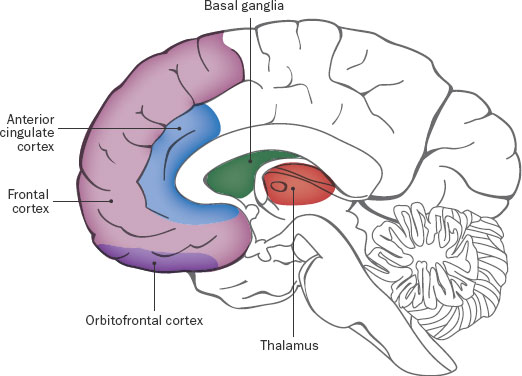
OCD Brain

Research suggests that OCD involves problems in communication between the front part of the brain and deeper structures of the brain. These brain structures use a neurotransmitter (basically, a chemical messenger) called serotonin. Pictures of the brain at work also show that, in some people, the brain circuits involved in OCD become more normal with either medications that affect serotonin levels (serotonin reuptake inhibitors, or SRIs) or cognitive behavior therapy (CBT).

Is OCD Inherited?

Research shows that OCD does run in families, and that genes likely play a role in the development of the disorder. Genes appear to be only partly responsible for causing the disorder, though. No one really knows what other factors might be involved, perhaps an illness or even ordinary life stresses that may induce the activity of genes associated with the symptoms of OCD.

Some experts think that OCD that begins in childhood may be different from the OCD that begins in adults. For example, a recent review of twin studies [1] has shown that genes play a larger role when OCD starts in childhood (45-65%) compared to when it starts in adulthood (27-47%).

Source: International OCD Foundation